
The Andromeda Galaxy from GALEX
Why does the Andromeda Galaxy have a giant ring? Viewed in ultraviolet light, the closest major galaxy to our Milky Way Galaxy looks more like a ring galaxy than a spiral. The ring is highlighted beautifully in this newly released image mosaic ...

N159 and the Papillon Nebula
In a search for massive stars, the Hubble Space Telescope has peered into yet another spectacular region of star formation. This nebula, known as N159, spans over 150 light-years and is located in the neighboring Large Magellanic Cloud galaxy, ...

The Flight Of Helios
An example of solar-powered flight, NASA's Helios aircraft flew almost one hundred years after the Wright brothers' historic flight on December 17, 1903. Pictured here at 10,000 feet in in skies northwest of Kauai, Hawaii in August 2001, the ...

Inside the Elephant's Trunk
Spectacular first images from the newly christened Spitzer Space Telescope include this penetrating interior view of an otherwise opaque dark globule known as the Elephant's Trunk Nebula. Seen in a composite of infrared image data recorded by ...

Express to Mars
Hurtling toward its destination, the high resolution camera on board ESA's Mars Express spacecraft recorded this tantalizing view of the Red Planet earlier this month on December 3rd. Seen from a distance of 5.5 million kilometers, features ...

A Proton Aurora
What are auroras made out of? Triggered by solar activity, normal auroras are caused by collisions between fast-moving electrons and the oxygen and nitrogen in Earth's upper atmosphere. The electrons come from the magnetosphere, the region of ...
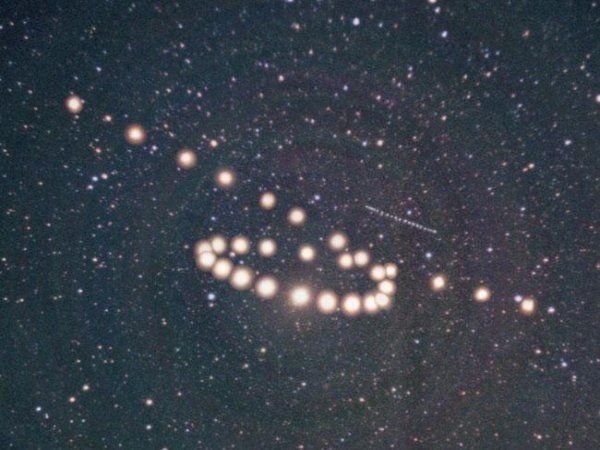
Retrograde Mars
Why would Mars appear to move backwards? Most of the time, the apparent motion of Mars in Earth's sky is in one direction, slow but steady in front of the far distant stars. About every two years, however, the Earth passes Mars as they orbit ...

Open Star Clusters M35 and NGC 2158
Open clusters of stars can be near or far, young or old, and diffuse or compact. Open clusters may contain from 100 to 10,000 stars, all of which formed at nearly the same time. Bright blue stars frequently distinguish younger open clusters. ...

Close-up of the Face on Mars
Wouldn't it be fun if clouds were turtles? Wouldn't it be fun if the laundry on the bedroom chair were a friendly monster? Wouldn't it be fun if rock mesas on Mars were faces or interplanetary monuments? Clouds, though, are small water ...

A Flock of Stars
Only a few stars can be found within ten light-years of our lonely Sun, situated near an outer spiral arm of the Milky Way galaxy. But if the Sun were found within one of our galaxy's star clusters, thousands of stars might occupy a similar ...
Internationale Raumstation
Kauf uns einen Kaffee!

