
An Apollo 15 Panorama
The Apollo 15 mission to Earth's Moon was dedicated to better understanding the surface of the moon by exploring mountains, valleys, maria, and highlands. Astronauts David Scott and James Irwin spent nearly three days on the Moon while Alfred ...

NGC 2440: Cocoon of a New White Dwarf
Like a butterfly, a white dwarf star begins its life by casting off a cocoon that enclosed its former self. In this analogy, however, the Sun would be a caterpillar and the ejected shell of gas would become the prettiest of all! The above ...

Two Worlds, One Sun
Two Worlds, One Sun, is the legend emblazoned on the Spirit rover's camera calibration target. Resting on the rover's rear deck, it also doubles as a sundial, allowing students to determine the solar time at Spirit's landing site on Mars. ...

Sol 5 Postcard from Mars
A martian Sol - the average martian solar day - is about 39 minutes longer than Earth's familiar 24 hour day. Operating on martian time, the Spirit rover recently sent back this color postcard image, recorded on Sol 5 of its stay on the martian ...

The Hills of Mars
Distant hills rise above a rocky, windswept plain in this sharp stereo scene from the Spirit rover on Mars. When viewed with red/blue glasses, the picture combines left and right images from Spirit's high resolution panoramic camera to yield a ...

Red Mars from Spirit
Rocks are strewn across the broad, flat Gusev crater floor in this sharp color picture from NASA's Spirit rover. Recorded by the rover's panoramic camera, the picture is part of Spirit's first color image of Mars - the highest resolution picture ...

Spirit's 3D View Toward Sleepy Hollow
Working late, tired mission members nicknamed the smooth-looking depression to the left of center in this image from the martian surface, Sleepy Hollow. The picture is a portion of the 3D panorama of the Spirit rover's landing site released ...

Spirit Pan from Gusev Crater
After a seven month voyage of nearly 500 million kilometers through interplanetary space, NASA's Spirit Rover has reached the surface of Mars. Scroll right and see a mosaic panorama of Spirit's first images returned from its landing site in Gusev ...
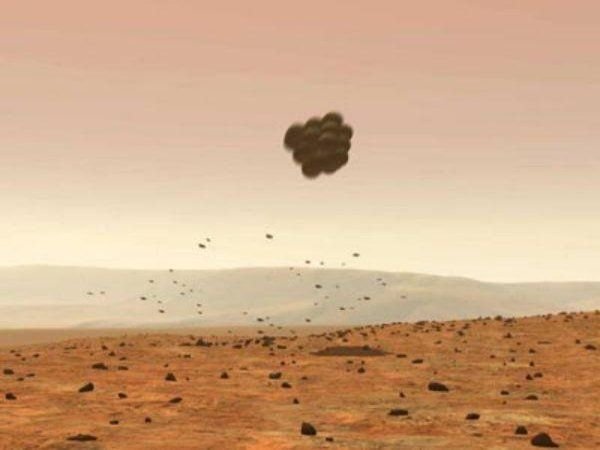
Spirit Rover Bounces Down on Mars
After a seven month voyage through interplanetary space, NASA's Spirit Rover has reached the surface of the Red Planet and returned the first images from its landing site in Gusev crater! The entry, descent, and landing phase of its mission - ...

Comet Wild 2's Nucleus from Stardust
What does a comet nucleus look like? Yesterday the robot spacecraft Stardust answered this question by returning the most detailed images yet of the center of a comet. The icy centers of comets are usually hidden from Earth-bound telescopes by ...
Internationale Raumstation
Kauf uns einen Kaffee!

