
A Passing Spaceship Views Earth
This is how Earth appeared to the passing spacecraft NEAR. The Near Earth Asteroid Rendezvous (NEAR) spacecraft was launched from Florida, USA, planet Earth in 1996. After a quick flyby of asteroid Mathilde in June last year, NEAR passed the ...

A Magellanic Mural
Two galaxies stand out to casual observers in Earth's Southern Hemisphere: the Large Magellanic Cloud (LMC) and the Small Magellanic Cloud (SMC). These irregular galaxies are two of the closest galaxies to our Milky Way Galaxy. Recent ...

A Triple Eclipse on Jupiter
Part of Jupiter is missing. Actually, three parts appear to be missing. In reality though, the three dark spots seen in the above photograph are only shadows. The unusual alignment of three of Jupiter's moons between the Jovian giant and the ...
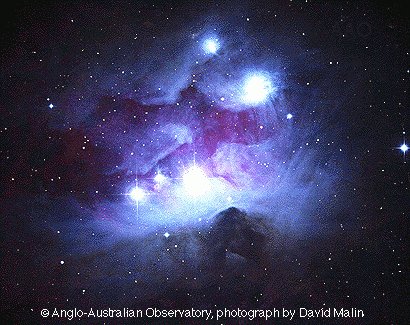
NGC 1977: Blue Reflection Nebula in...
The Orion Nebula is visible to the unaided eye as a fuzzy patch near the famous belt of three stars in the constellation Orion. The above picture captures a part of the Orion Nebula that primarily reflects light from bright Orion stars. This ...

Hamlet of Oberon
What's in a name? Since 1919, the International Astronomical Union has been charged with the task of establishing "conventional" nomenclature for planets, satellites, and surface features. For the remote Uranian system of moons, namesakes from ...

Tempel-Tuttle: The Leonid Comet
Star trails streak this composite time exposure of Comet Tempel-Tuttle recorded by T. Puckett on January 26. Presently passing through the inner solar system on its 33 year orbit around the Sun, Tempel-Tuttle has brightened unexpectedly, but ...

The Earth-Moon System
This evocative mosaic image of the Earth-Moon system was recorded by NASA's Near Earth Asteroid Rendezvous (NEAR) spacecraft earlier this month. The relative sizes shown are appropriate for viewing both the Earth and Moon from a distance of about ...

The Infrared Sky
Three major sources contribute to the far-infrared sky: our Solar System, our Galaxy, and our Universe. The above image, in representative colors, is a projection of the entire infrared sky created from years of observations by the robot ...

The Great Nebula in Orion
The Great Nebula in Orion can be found just below and to the left of the easily identifiable belt of three stars in the popular constellation Orion. This fuzzy patch contains one of the closest stellar nurseries, lying at a distance of about 1500 ...

Interplanetary Spacecraft Passes Earth
Last Thursday an interplanetary spacecraft flew right past the Earth. The above images show sunlight momentarily reflected from this spacecraft's solar panels. No aliens were involved - the Near Earth Asteroid Rendezvous (NEAR) mission actually ...
Internationale Raumstation
Kauf uns einen Kaffee!

