
The Rosette Nebula
Would the Rosette Nebula by any other name look as sweet? The bland New General Catalog designation of NGC 2237 doesn't appear to diminish the appearance of the this flowery emission nebula. Inside the nebula lies an open cluster of bright young ...

Explorer I
Inaugurating the era of space exploration for the US, the First Explorer was launched into Earth orbit forty years ago (February 1, 1958) by the Army Ballistic Missle Agency. The Explorer I satellite weighed about 30 pounds, was 6 feet long, 6 ...

In A Grand Canyon On Mars
In a grand canyon on Mars, steep slopes fall away from a smooth plateau revealing striking layered rock formations. The canyon is part of the Valles Marineris, a 2,500 mile long system of canyons cutting across the Martian equator. This view, ...

Ultra-Fast Pulsar
Pulsars are rotating neutron stars, born in the violent crucibles of supernova explosions. Like cosmic lighthouses, beams of radiation from surface hotspots sweep past our viewpoint creating pulses which reveal the rotation rates of these ...

All of Mars
Mars Global Surveyor is photographing Mars. The robot spacecraft arrived last September and continues to use solar panel aerobraking to help maneuver it to a better orbit to survey all of Mars The above image is a reconstruction of several ...

The Witch Head Nebula
Double, double toil and trouble; Fire burn, and cauldron bubble ... Maybe Macbeth should have consulted the Witch Head Nebula. This suggestively shaped reflection nebula is associated with the bright star Rigel in the constellation Orion. More ...
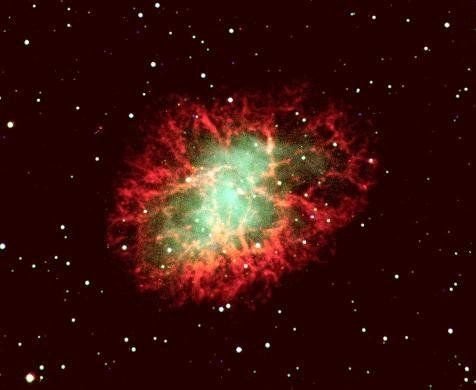
M1: Filaments of the Crab Nebula
The Crab Nebula, filled with mysterious filaments, is the result of a star that exploded in 1054 AD. This spectacular supernova explosion was recorded by Chinese and (quite probably) Anasazi Indian astronomers. The filaments are mysterious ...

COBE Hotspots: The Oldest Structures...
Above is a microwave image of the entire sky. The plane of our galaxy runs horizontally through the center. This historic all-sky map is based on the first two years of data from NASA's COsmic Background Explorer (COBE) satellite. After computer ...

Happy Birthday Jules Verne
Sunday marks the 170th anniversary of the birth of Jules Verne (born in Nantes, France on the 8th of February, 1828). Inspired by a lifelong fascination with machines, Verne wrote visionary works about "Extraordinary Voyages" including such ...

A Martian River Bed?
This canyon on the surface of Mars appears to have been carved by flowing water. Known as Nanedi Vallis, the terraces and channels visible within the canyon strongly suggest that a river of water once ran here. But the lack of smaller surface ...
Internationale Raumstation
Kauf uns einen Kaffee!

