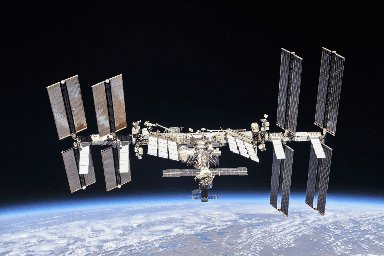
Canadarm2 Grips Cargo Spacecraft, Spacewalk Prep and Biology Continue

A JAXA (Japan Aerospace Exploration Agency) cargo spacecraft is in the grasp of the Canadarm2 robotic arm following its detachment from the International Space Station's Harmony module on Thursday. The Expedition 74 crew continued its spacewalk preparations, transferred more cargo, and conducted biology research throughout the day.
The HTV-X1 cargo spacecraft was uninstalled from Harmony with the Canadarm2 at 2:26 p.m. EST Thursday and maneuvered to an overnight parking position. During the crew's sleep shift, Japanese mission controllers will conduct a laser ranging sensor demonstration test with HTV-X1 still held by the robotic arm.
Then at 12 p.m. EST on Friday, robotics controllers will command the Canadarm2 to release HTV-X1 into Earth orbit. The spacecraft will remain at a safe distance from the station for approximately three months while conducting a series of remotely controlled science experiments. NASA will broadcast the release live, beginning at 11:45 a.m. Friday on NASA+, Amazon Prime, and the agency's YouTube channel.
While robotic operations continued outside the space station, the astronauts pressed ahead with spacewalk preparations. NASA flight engineers Jessica Meir, Chris Williams, and Jack Hathaway gathered together and reviewed the tools and equipment required to install a modification kit and route cables for a future roll-out solar array on the port side of the orbital outpost. NASA will soon announce the date and name the two spacewalkers who will exit the station's Quest airlock into the vacuum of space for the roll-out solar array preparation work.
ESA (European Space Agency) astronaut Sophie Adenot began her shift packing cargo for disposal inside Northrop Grumman's Cygnus XL cargo spacecraft attached to the Unity module's Earth-facing port. Cygnus will conclude its mission soon at the orbital outpost that began on Sept. 18 with its robotic capture and installation to Unity. Adenot also worked in the Kibo laboratory module removing computer and electronics hardware for stowage and later reuse.
Cosmonauts Sergey Kud-Sverchkov and Sergei Mikaev teamed up early Thursday for a Roscosmos digestion study. Shortly after waking, the duo scanned their stomachs with an ultrasound device before eating their breakfast. After their meal, the station commander and flight engineer repeated the stomach scans helping researchers understand how the digestive system adapts to weightlessness.
Flight Engineer Andrey Fedyaev kicked off his shift servicing the Elektron oxygen generator and its components in the station's Roscosmos segment. Fedyaev then inspected video recording gear, downloaded video and imagery for mission controllers, and installed automated Earth observation hardware to capture imagery of islands across the Asia-Pacific region.
Learn more about station activities by following the space station blog, @space_station on X, as well as the ISS Facebook and ISS Instagram accounts.
Get the latest from NASA delivered every week. Subscribe here.
Mark A. Garcia
Vielen Dank, dass Sie den Artikel gelesen haben!