
Mars: 3-D Dunes
Get out your red/blue glasses and treat yourself to this dramatic 3-D view of sand dunes on Mars! The field of undulating dunes is found in Nili Patera, a volcanic depression in central Syrtis Major, the most prominent dark feature on the Red ...

X-Rays from the Galactic Plane
In February 2000, the orbiting Chandra X-ray Observatory spent 27 hours staring into the plane of our Milky Way galaxy. Its target was a spot in the small constellation Scutum, within the Milky Way's zone of avoidance where galactic gas and dust ...

A Piece of Interplanetary Dust
The dust that pervades our Solar System is not the dust that pervades our homes. Solar System dust comes from comets and asteroids, whereas house dust is most likely lint or dead cells. Pictured above is a piece of interplanetary dust caught by ...
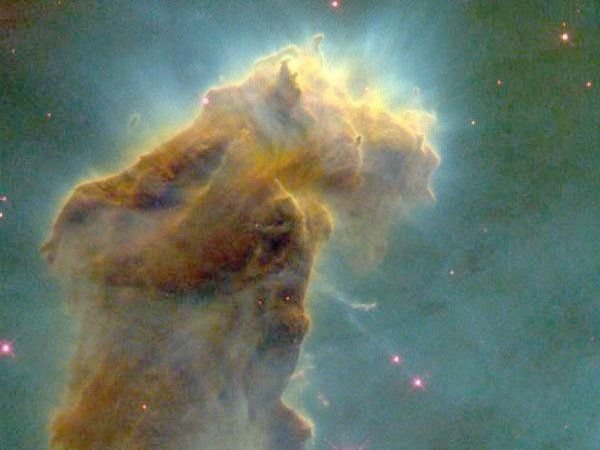
Eagle EGGs in M16
Star forming regions known as "EGGs" are uncovered at the end of this giant pillar of gas and dust in the Eagle Nebula (M16). EGGs, short for evaporating gaseous globules, are dense regions of mostly molecular hydrogen gas that fragment and ...

A Mystery In Gamma Rays
Gamma rays are the most energetic form of light, packing a million or more times the energy of visible light photons. If you could see gamma rays, the familiar skyscape of steady stars would be replaced by some of the most bizarre objects known ...

Perseids of Summer
Like falling stardust, cast off bits of comet Swift-Tuttle hurtle through the upper atmosphere about this time each year as planet Earth passes near the comet's orbital path. For the northern hemisphere, this regular celestial display is known as ...
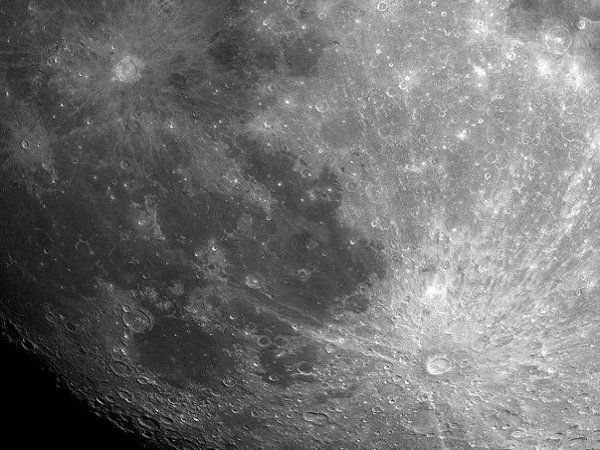
Tycho and Copernicus: Lunar Ray Craters
Dazzling in binoculars or a small telescope, the Moon is pocked with impact craters. During partial lunar phases, the craters along the terminator are cast in dramatic relief by strong shadows. But when the Moon is full some craters seem to ...

A July Dawn
Those up before dawn in late July in the northern hemisphere could see planets, stars, and a spacecraft in a single quick glance before starting their day. Near the eastern horizon was bright Jupiter, and not far above and to its right was the ...

The Orbiting Hubble Space Telscope
The Hubble Space Telescope (HST) is the largest orbiting public optical telescope in history. Its 2.4 meter diameter reflecting mirror and its perch above Earth's atmosphere allow it to create exceptionally sharp images. Originally launched in ...

NGC 2440: Cocoon of a New White Dwarf
Like a butterfly, a white dwarf star begins its life by casting off a cocoon that enclosed its former self. In this analogy, however, the Sun would be a caterpillar and the ejected shell of gas would become the prettiest of all! The above ...
Internationale Raumstation
Kauf uns einen Kaffee!


