
Leonids Over Joshua Tree National Park
This year's Leonid Meteor Shower is predicted to have two peaks, like last year's. The first peak should come at about 04:00 hours Universal Time (UT) on November 19 and be primarily visible from Western Europe before sunrise. The second peak ...

Cassini Approaches Saturn
Cassini, a robot spacecraft launched in 1997 by NASA, is close enough now to resolve many rings and moons of its destination planet: Saturn. The spacecraft has closed to about two Earth-Sun separations from the ringed giant. Last month, Cassini ...

The International Space Station...
The developing International Space Station (ISS) has changed its appearance yet again. Last month the Space Shuttle Atlantis visited the ISS and installed the third of eleven pieces that will compose the Integrated Truss Structure. The new S-1 ...
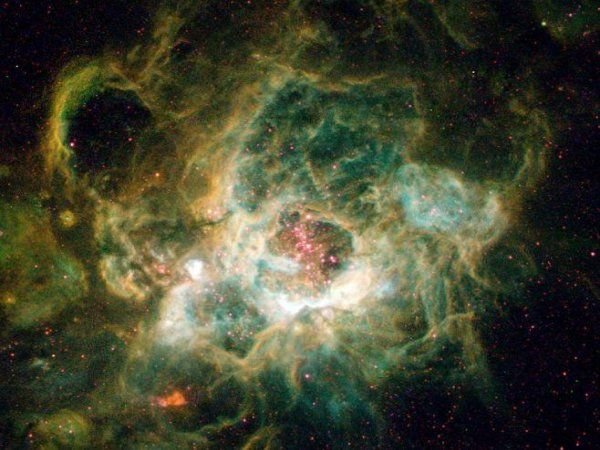
NGC 604: Giant Stellar Nursery
Scattered within this cavernous nebula, cataloged as NGC 604, are over 200 newly formed hot, massive, stars. At 1,500 light-years across, this expansive cloud of interstellar gas and dust is effectively a giant stellar nursery located some three ...

Europa's Freckles
uropa, one of Jupiter's large Galilean moons, may well possess an ocean of liquid water hidden beneath its icy surface -- and so holds the tantalizing possibility of life. In this image, constructed with data recorded in 1996 and 1997 by the ...

Leonids Over Uluru
Will this year's Leonid meteor shower be as good as last year's? No one knows for sure. Possibly, however, in the waning nighttime hours of November 18 and lasting throughout much of November 19, sky gazers across the globe may get their last ...

A Lunar Rille
What could cause a long indentation on the Moon? First discovered over 200 years ago with a small telescope, rilles (rhymes with pills) appear all over the Moon. Three types of rilles are now recognized: sinuous rilles, which have many ...

Earth's Richat Structure
What on Earth is that? The Richat Structure in the Sahara Desert of Mauritania is easily visible from space because it is nearly 50 kilometers across. Once thought to be an impact crater, the Richat Structure's flat middle and lack of ...

Asteroid Gaspra's Best Face
Asteroid 951 Gaspra is a huge rock tumbling in space. Gaspra became one of the best-studied asteroids in 1991 when the spacecraft Galileo flew by. In the above photograph, subtle color variations have been exaggerated to highlight changes in ...

Dark Matter, X-rays, and NGC 720
cal galaxy NGC 720 is enveloped in a cosmic cloud of x-ray emitting gas. Seen in this false color image from the Chandra X-ray Observatory, the extreme temperature of the gas - about 7 million degrees Celsius - makes it impossible to confine the ...
Internationale Raumstation
Kauf uns einen Kaffee!

