
Springtime on Mars
Vast canyons, towering volcanoes, sprawling fields of ice, deep craters, and high clouds can all be seen in this image of the Solar System's fourth planet: Mars. The orbiting robot Mars Global Surveyor spacecraft took the above mosaic of images ...

The Gum Nebula Supernova Remnant
Because the Gum Nebula is the closest supernova remnant, it is actually hard to see. Spanning 40 degrees across the sky, the nebula is so large and faint it is easily lost in the din of a bright and complex background. The Gum Nebula, ...

Spiral Galaxy In Centaurus
Centaurus, the Centaur, is one of the most striking constellations in the southern sky. The lovely Milky Way flows through this large constellation whose celestial wonders also include the closest star to the sun, Alpha Centauri, the largest ...

Double Eruptive Prominences
Lofted over the Sun on looping magnetic fields, large solar prominences are composed of relatively cool, dense plasma. When seen against the brilliant solar disk they appear as dark filaments, but these enormous magnetic structures are bright ...

M106 in Canes Venatici
Close to the Great Bear (Ursa Major) and surrounded by the stars of the Hunting Dogs (Canes Venatici), this celestial nebula was discovered in 1781 by the metric French astronomer Pierre Mechain and later added to the catalog of his friend and ...

Magma Bubbles from Mt. Etna
Mt. Etna erupted spectacularly in 2001 June. Pictured above, the volcano was photographed expelling bubbles of hot magma, some of which measured over one meter across. One reason planetary geologists study Earth's Mt. Etna is because of its ...

A Crescent Nebula Star Field
What caused the Crescent Nebula? Looking like an emerging space cocoon, the Crescent Nebula, visible on the right, was created by the brightest star in its center. A leading progenitor hypothesis has the Crescent Nebula beginning to form about ...

A Gamma Ray Burst - Supernova Connection
New evidence has emerged that a mysterious type of explosion known as a gamma ray burst is indeed connected to a supernova of the type visible in the above image. Two weeks ago, the orbiting HETE satellite detected gamma-ray burst GRB030329. ...
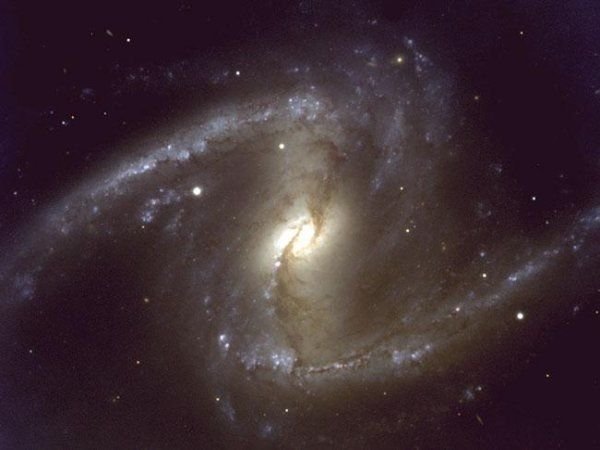
NGC 1365: A Nearby Barred Spiral Galaxy
Many spiral galaxies have bars across their centers. Even our own Milky Way Galaxy is thought to have a bar, but perhaps not so prominent as the one in NGC 1365, shown above. The persistence and motion of the bar imply relatively massive ...

Mercury on the Horizon
Have you ever seen the planet Mercury? Because Mercury orbits so close to the Sun, it never wanders far from the Sun in Earth's sky. If trailing the Sun, Mercury will be visible low on the horizon for only a short while after sunset. If leading ...
Internationale Raumstation
Kauf uns einen Kaffee!

