
Analemma over Ukraine
If you took a picture of the Sun at the same time each day, would it remain in the same position? The answer is no, and the shape traced out by the Sun over the course of a year is called an analemma. The Sun's apparent shift is caused by the ...

Lunar Orbiter Views Crater Copernicus
To prepare for the Apollo landings, five Lunar Orbiter spacecraft were launched during 1966 and 1967 to gather detailed images of our fair planet's large, natural satellite. Dramatic views returned by the spacecraft cameras included this stark ...

Messier 96
Dust lanes seem to swirl around the core of Messier 96 in this colorful, detailed portrait of the beautiful island universe. Of course M96 is a spiral galaxy, and counting the faint arms extending beyond the brighter central region it spans 100 ...

vdB 152: Reflection Nebula in Cepheus
Described as a "dusty curtain" or "ghostly apparition", mysterious reflection nebula vdB 152 really is very faint. It lies about 1400 light-years away, along the northern Milky Way in the royal constellation Cepheus. Near the edge of a large ...

Warped Sky: Star Trails Panorama
What's happened to the sky? A time warp, of sorts, and a digital space warp too. The time warp occurs because the above image captured in a single frame a four hour exposure of the night sky. Prominent and picturesque star trails are visible. ...

Shuttle Plume
What kind of cloud is that? Not a naturally occurring one. Pictured above is the drifting smoke plume left over from last Friday's launch of the Space Shuttle Atlantis. The twisted plume was captured shortly after launch high above NASA's ...
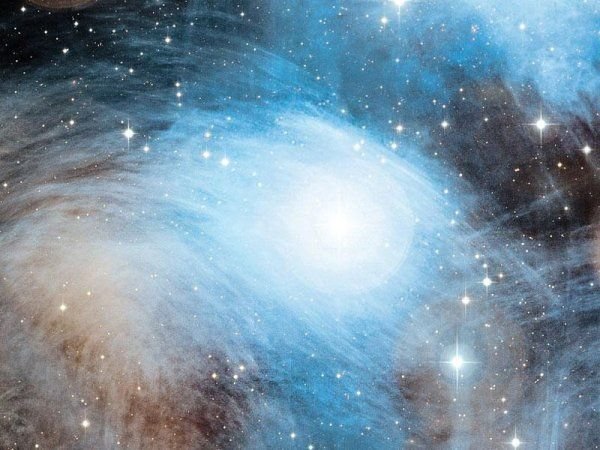
The Merope Reflection Nebula
Reflection nebulas reflect light from a nearby star. Many small carbon grains in the nebula reflect the light. The blue color typical of reflection nebula is caused by blue light being more efficiently scattered by the carbon dust than red ...

Looking Back at an Eclipsed Earth
Here is what the Earth looks like during a solar eclipse. The shadow of the Moon can be seen darkening part of Earth. This shadow moved across the Earth at nearly 2000 kilometers per hour. Only observers near the center of the dark circle see ...

Globular Star Cluster M3
This immense ball of half a million stars older than the Sun lies over 30,000 light-years away. Cataloged as M3 (and NGC 5272), it is one of about 150 globular star clusters that roam the halo of our Milky Way Galaxy. Even in this impressively ...

Markarian's Eyes
Across the heart of the Virgo Galaxy Cluster lies a string of galaxies known as Markarian's Chain. Prominent in Markarian's Chain are these two interacting galaxies, NGC 4438 (left) and NGC 4435 - also known as The Eyes. About 50 million ...
Internationale Raumstation
Kauf uns einen Kaffee!

