
A Twisted Solar Eruptive Prominence
Ten Earths could easily fit in the "claw" of this seemingly solar monster. The monster, though, visible on the lower left, is a huge eruptive prominence seen moving out from our Sun. The above dramatic image taken early in the year 2000 by the ...

A View to the Sunset
ch day on planet Earth can have a dramatic ending as the Sun sets below the colorful western horizon. Often inspiring, or offering a moment for contemplation, a sunset is perhaps the single most photographed celestial event. Did you recognize ...

Descent of the Phoenix
In this sweeping view, the 10 kilometer-wide crater Heimdall lies on the north polar plains of Mars. But the bright spot highlighted in the inset is the Phoenix lander parachuting toward the surface. The amazing picture was captured on May 25th ...
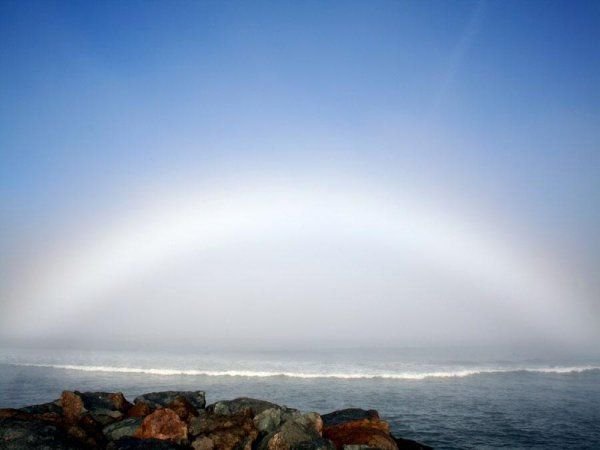
A Fog Bow Over Ocean Beach
What is that white arch over the water? What is being seen is a fogbow, a reflection of sunlight by water drops similar to a rainbow but without the colors. The fog itself is not confined to an arch -- the fog is mostly transparent but ...

Dark Clouds of the Carina Nebula
What dark forms lurk in the mists of the Carina Nebula? These ominous figures are actually molecular clouds, knots of molecular gas and dust so thick they have become opaque. In comparison, however, these clouds are typically much less dense ...

Phoenix at Mars
The Phoenix lander's footpads are about the size of a dinner plate. One of three is shown at the right, covered with Martian soil after a successful soft landing on the Red Planet on May 25. Amazingly, the left panel image is of the spacecraft ...

A New Horizon for Phoenix
This flat horizon stretches across the red planet as seen by the Phoenix spacecraft after yesterday's landing on Mars. Touching down shortly after 7:30pm Eastern Time, Phoenix made the first successful soft landing on Mars, using rockets to ...
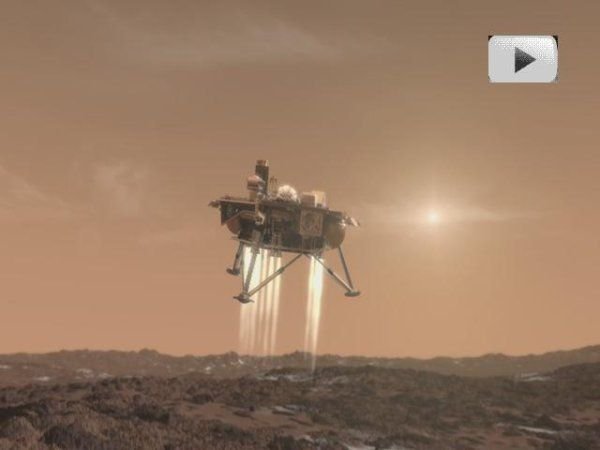
Phoenix Lander Arrives at Mars
Will Phoenix survive its landing today on Mars? Phoenix's landing sequence will ramp up starting at about 7:30 pm EDT (23:30 UTC) today and last just over an hour. If all goes well, one of Phoenix's first images from Mars will appear on APOD ...

Space Station in the Sun
Still bathed in sunlight, the International Space Station tracked through night skies above Hombressen, Germany on May 12. From a range of at least 360 kilometers, astronomer Dirk Ewers was able to record an impressively sharp video sequence of ...

Jupiter's Three Red Spots
For about 300 years Jupiter's banded atmosphere has shown a remarkable feature to telescopic viewers, a large swirling storm system known as The Great Red Spot. In 2006, another red storm system appeared, actually seen to form as smaller whitish ...
Internationale Raumstation
Kauf uns einen Kaffee!


