
A Partial Eclipse Over Manila Bay
What's happened to the setting Sun? An eclipse! Two days ago, the Moon eclipsed part of the Sun as visible from parts of Africa, Australia, and Asia. In particular the above image, taken from the Mall of Asia seawall, caught a partially ...

The Milky Way Over Mauna Kea
Have you ever seen the band of our Milky Way Galaxy? In a clear sky from a dark location at the right time, a faint band of light becomes visible across the sky. Soon after your eyes become dark adapted, you might spot the band for the first ...

AE Aurigae and the Flaming Star Nebula
Is star AE Aurigae on fire? No. Even though AE Aurigae is named the flaming star, the surrounding nebula IC 405 is named the Flaming Star Nebula, and the region appears to harbor red smoke, there is no fire. Fire, typically defined as the rapid ...

Annular Eclipse: The Ring of Fire
Tomorrow, a few lucky people may see a "ring of fire." That's a name for the central view of an annular eclipse of the Sun by the Moon. At the peak of this eclipse, the middle of the Sun will appear to be missing and the dark Moon will appear ...

The Bubble Nebula
Blown by the wind from a massive star, this interstellar apparition has a surprisingly familiar shape. Cataloged as NGC 7635, it is also known simply as The Bubble Nebula. This colorful telescopic image includes a long exposure through a hydrogen ...

Globular Cluster NGC 2419
Of three objects prominent in this thoughtful telescopic image, a view toward the stealthy constellation Lynx, two (the spiky ones) are nearby stars. The third is the remote globular star cluster NGC 2419, at distance of nearly 300,000 ...
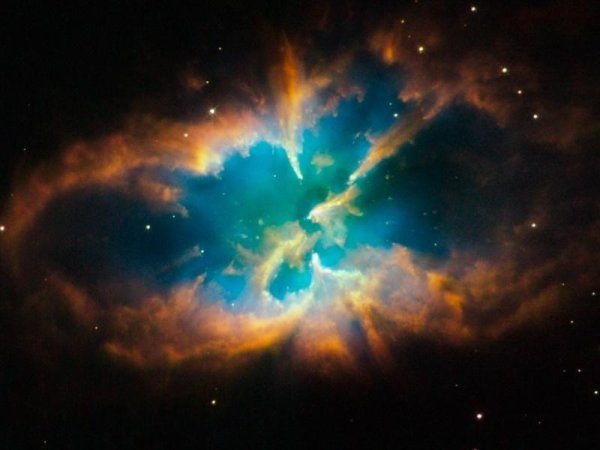
Planetary Nebula NGC 2818
NGC 2818 is a beautiful planetary nebula, the gaseous shroud of a dying sun-like star. It could well offer a glimpse of the future that awaits our own Sun after spending another 5 billion years or so steadily using up hydrogen at its core, and ...

A Lenticular Cloud Over New Zealand
What's happening above those mountains? Several clouds are stacked up into one striking lenticular cloud. Normally, air moves much more horizontally than it does vertically. Sometimes, however, such as when wind comes off of a mountain or a ...

Bonestell Panorama from Mars
If you could stand on Mars -- what could you see? One memorable vista might be the above 360-degree panoramic image taken by the robotic Spirit rover over the last year. The above image involved over 200 exposures and was released as part of ...

Methane Discovered in the Atmosphere...
Why is there methane on Mars? No one is sure. An important confirmation that methane exists in the atmosphere of Mars occurred last week, bolstering previous controversial claims made as early as 2003. The confirmation was made ...
Internationale Raumstation
Kauf uns einen Kaffee!


