
Fermi's Gamma-Ray Sky
Scanning the entire sky in gamma-rays, photons with over 50 million times the energy of visible light, the Fermi mission's Large Area Telescope (LAT) explores the high-energy universe. This all-sky map constructed from 3 months of LAT ...

Sunset at the Portara
Today, the Sun crosses the celestial equator heading north at 11:44 UT. Known as an equinox, this astronomical event marks the first day of spring in the northern hemisphere and autumn in the south. It also marks the beginning of Norouz, the ...

Saturn: Moons in Transit
very 14 to 15 years, Saturn's rings are tilted edge-on to our line of sight. As the bright, beautiful rings seem to grow narrower it becomes increasingly difficult to see them, even with large telescopes. But it does provide the opportunity to ...

GLOBE at Night: Help Track Light...
How many stars can you see? Through next week, the GLOBE at Night project invites people from all over the world to go outside at night, look up, and see! Specifically, people are invited to go out an hour after sunset and look for the ...

Tycho's Supernova Remnant
What star created this huge puffball? Pictured above is the best multi-wavelength image yet of Tycho's supernova remnant, the result of a stellar explosion first recorded over 400 years ago by the famous astronomer Tycho Brahe. The above image ...
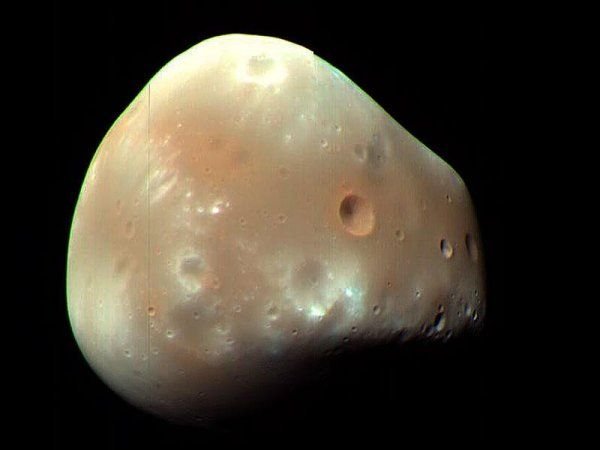
Martian Moon Deimos from MRO
Mars has two tiny moons, Phobos and Deimos. Pictured above, in a recently release image by HiRISE camera onboard the Mars-orbiting Mars Reconnaissance Orbiter (MRO), is Deimos, the smaller moon of Mars. Deimos is one of the smallest known moons ...

A Prominent Solar Prominence from SOHO
What's happened to our Sun? It was sporting a spectacular -- but not very unusual -- solar prominence. A solar prominence is a cloud of solar gas held above the Sun's surface by the Sun's magnetic field. In 2004, NASA's Sun-orbiting SOHO ...

Haute-Provence Star Trails
Fix your camera to a tripod and you can record the graceful trails traced by the stars as planet Earth rotates on its axis. For example, this dramatic 5 hour long exposure was made on February 24 from Haute-Provence Observatory (OHP) in ...

Hickson Compact Group 90
Scanning the skies for galaxies, Canadian astronomer Paul Hickson and colleagues identified some 100 compact groups of galaxies, now appropriately called Hickson Compact Groups (HCGs). This sharp Hubble image shows one such galaxy group, HCG 90, ...

Thor's Helmet (NGC 2359) and...
At the right, Thor's Helmet (NGC 2359) seems to gaze across a lovely star field. The broad skyscape itself covers about 1.5 degrees or 3 full moons toward the constellation Canis Major. A close look at the lower left corner of the image might ...
Internationale Raumstation
Kauf uns einen Kaffee!

