
Aurora and Milky Way in a Little Sky
Stepping stones seem to lead to the Milky Way as it stretches across this little sky. Of course, the scene is really the northern hemisphere's autumnal equinox night. Water and sky are inverted by a top to bottom, around the horizon stereographic ...

The Bubble Nebula
Blown by the wind from a massive star, this interstellar apparition has a surprisingly familiar shape. Cataloged as NGC 7635, it is also known simply as The Bubble Nebula. Although it looks delicate, the 10 light-year diameter bubble offers ...
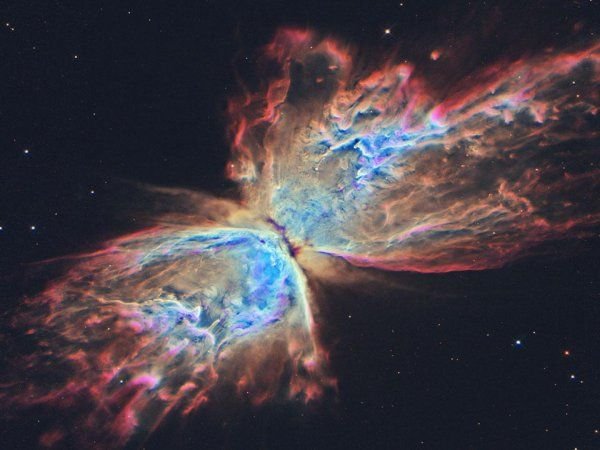
The Butterfly Nebula from Hubble
The bright clusters and nebulae of planet Earth's night sky are often named for flowers or insects. Though its wingspan covers over 3 light-years, NGC 6302 is no exception. With an estimated surface temperature of about 250,000 degrees C, the ...

A Full Circle Rainbow over Australia
Have you ever seen an entire rainbow? From the ground, typically, only the top portion of a rainbow is visible because directions toward the ground have fewer raindrops. From the air, though, the entire 360 degree circle of a rainbow is more ...

Unusual Rocks near Pahrump Hills on Mars
How did these Martian rocks form? As the robotic Curiosity rover has approached Pahrump Hills on Mars, it has seen an interesting and textured landscape dotted by some unusual rocks. The featured image shows a curiously round rock spanning about ...

Two Black Holes Dancing in 3C 75
What's happening at the center of active galaxy 3C 75? The two bright sources at the center of this composite x-ray (blue)/ radio (pink) image are co-orbiting supermassive black holes powering the giant radio source 3C 75. Surrounded by ...

A Launch and a Landing
Taken from an Atlantic beach, Cape Canaveral, planet Earth, four identically framed digital images are combined in this night skyscape. Slightly shifted short star trails dot the sky, but the exposure times were adjusted to follow the flight of a ...

MAVEN at Mars
Launched on November 18, 2013, the MAVEN (Mars Atmosphere and Volatile EvolutioN) spacecraft completed its interplanetary voyage September 21, captured into a wide, elliptical orbit around Mars. MAVEN's imaging ultraviolet spectrograph has ...

NGC 206 and the Star Clouds of Andromeda
The large stellar association cataloged as NGC 206 is nestled within the dusty arms of the neighboring Andromeda galaxy. Also known as M31, the spiral galaxy is a mere 2.5 million light-years away. NGC 206 is near top center in this gorgeous ...

The Lagoon Nebula in Stars Dust and Gas
The large majestic Lagoon Nebula is home for many young stars and hot gas. Spanning 100 light years across while lying only about 5000 light years distant, the Lagoon Nebula is so big and bright that it can be seen without a telescope toward the ...
Internationale Raumstation
Kauf uns einen Kaffee!

