
Solar Flare from a Sharper Sun
Solar active region AR2192 was the largest recorded sunspot group of the last 24 years. Before rotating off the Earth-facing side of the Sun at the end of October, it produced a whopping six energetic X-class flares. Its most intense flare was ...

M1: The Crab Nebula
The Crab Nebula is cataloged as M1, the first object on Charles Messier's famous 18th century list of things which are not comets. In fact, the Crab is now known to be a supernova remnant, debris from the death explosion of a massive star, ...

LDN 988: Dark Nebula in Cygnus
Obscuring the rich starfields of northern Cygnus, dark nebula LDN 988 lies near the center of this cosmic skyscape. Composed with telescope and camera, the scene is some 2 degrees across. That corresponds to 70 light-years at the estimated 2,000 ...

Bright Spiral Galaxy M81
One of the brightest galaxies in planet Earth's sky is similar in size to our Milky Way Galaxy: big, beautiful M81. This grand spiral galaxy can be found toward the northern constellation of the Great Bear (Ursa Major). This superbly detailed ...

Star Formation in the Tadpole Nebula
Dusty emission in the Tadpole nebula, IC 410, lies about 12,000 light-years away in the northern constellation Auriga. The cloud of glowing gas is over 100 light-years across, sculpted by stellar winds and radiation from embedded open star ...
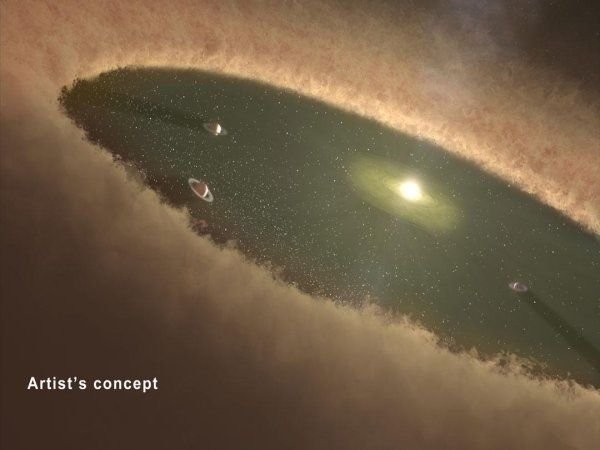
The Double Dust Disks of HD 95086
What do other star systems look like? To help find out, astronomers are carrying out detailed observations of nearby stars in infrared light to see which have dust disks that might be forming planets. Observations by NASA's Spitzer Space ...

Leonids Above Torre de la Guaita
Leonids Meteor Shower came to an impressive crescendo in 1999. Observers in Europe saw a sharp peak in the number of meteors visible around 0210 UTC during the early morning hours of November 18. Meteor counts then exceeded 1000 per hour - the ...

The Tulip Nebula
Framing a bright emission region this telescopic view looks out along the plane of our Milky Way Galaxy toward the nebula rich constellation Cygnus the Swan. Popularly called the Tulip Nebula the glowing cloud of interstellar gas and dust is also ...

Welcome to a Comet
The Rosetta Mission lander is safely on a comet. One of Philae's feet appears at the bottom left of this spectacular image of the surface of C67/P Churyumov-Gerasimenko. Still a happy lander, Philae bounced twice before settling and returning ...

Descent to a Comet
Yesterday, the first soft landing on a comet took place some 500 million kilometers from planet Earth as the Rosetta mission lander Philae settled on the nucleus of C67/P Churyumov-Gerasimenko. The landing site, dubbed Agilkia, is located near ...
Internationale Raumstation
Kauf uns einen Kaffee!


