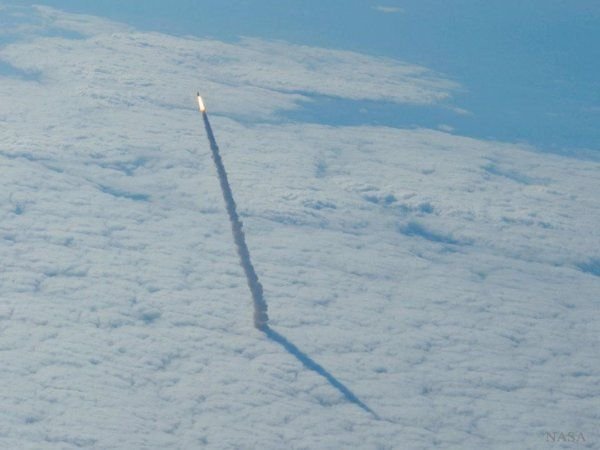
Space Shuttle Rising
What's that rising from the clouds? The space shuttle. Sometimes, if you looked out the window of an airplane at just the right place and time, you could have seen something very unusual -- a space shuttle launching to orbit. Images of the ...

NGC 7822 in Cepheus
Hot, young stars and cosmic pillars of gas and dust seem to crowd into NGC 7822. At the edge of a giant molecular cloud toward the northern constellation Cepheus, the glowing star forming region lies about 3,000 light-years away. Within the ...

A Dark and Dusty Sky
In the dusty sky toward the constellation Taurus and the Orion Arm of our Milky Way Galaxy, this broad mosaic follows dark and faint reflection nebulae along the region's fertile molecular cloud. The six degree wide field of view starts with long ...

NGC 6240: Merging Galaxies
NGC 6240 offers a rare, nearby glimpse of a cosmic catastrophe in its final throes. The titanic galaxy-galaxy collision takes place a mere 400 million light-years away in the constellation Ophiuchus. The merging galaxies spew distorted tidal ...

A Cliff Looming on Comet 67P
What's that looming behind this gravel-strewn hill on Comet ChuryumovGerasimenko? A jagged cliff. The unusual double-lobed nucleus of Comet 67P/ChuryumovGerasimenko lends itself to unusual and dramatic vistas, another of which has been captured ...

Globular Star Cluster 47 Tuc
Globular star cluster 47 Tucanae is a jewel box of the southern sky. Also known as NGC 104, it roams the halo of our Milky Way Galaxy along with over 150 other globular star clusters. The second brightest globular cluster (after Omega Centauri) ...

Auroras and Star Trails over Iceland
It was one of the quietest nights of aurora in weeks. Even so, in northern- Iceland during last November, faint auroras lit up the sky every clear night. The featured 360-degree panorama is the digital fusion of four wide-angle cameras each ...

NGC 2440: Pearl of a New White Dwarf
Like a pearl, a white dwarf star shines best after being freed from its shell. In this analogy, however, the Sun would be a mollusk and its discarded hull would shine prettiest of all! In the above shell of gas and dust, the planetary nebula ...

Ares 3 Landing Site: The Martian...
This close-up from the Mars Reconnaissance Orbiter's HiRISE camera shows weathered craters and windblown deposits in southern Acidalia Planitia. A striking shade of blue in standard HiRISE image colors, to the human eye the area would probably ...

Jupiter, Ganymede, Great Red Spot
In this sharp snapshot, the Solar System's largest moon Ganymede poses next to Jupiter, the largest planet. Captured on March 10 with a small telescope from our fair planet Earth, the scene also includes Jupiter's Great Red Spot, the Solar ...
Internationale Raumstation
Kauf uns einen Kaffee!

