
NASA's Curiosity Rover at Namib Dune...
Point or tilt to see a spectacular view of Mars visible to the Curiosity rover last December. In the foreground, part of Curiosity itself is visible, including its dusty sundial. Starting about seven meters back, the robotic rover is seen ...

Orion's Belt and Sword over Teide's Peak
The southern part of Orion, the famous constellation and mythical hunter, appears quite picturesque posing here over a famous volcano. Located in the Canary Islands off the northwest coast of Africa, the snow-peaked Teide is one of the largest ...
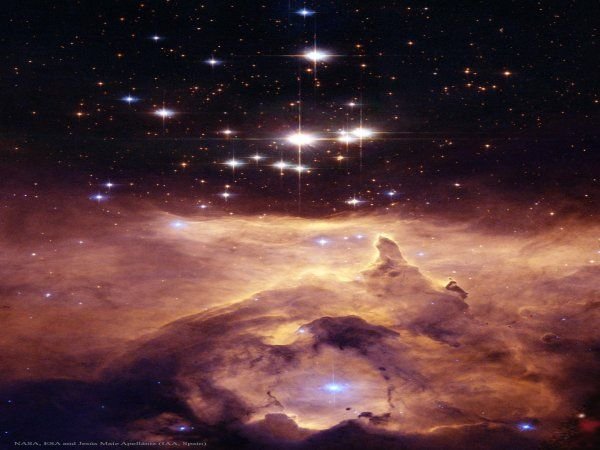
NGC 6357: Cathedral to Massive Stars
How massive can a normal star be? Estimates made from distance, brightness and standard solar models had given one star in the open cluster Pismis 24 over 200 times the mass of our Sun, making it one of the most massive stars known. This star ...

Solstice to Equinox Cubed
This 3 month long exposure packed the days from December 22, 2015 through March 20 into a box. Dubbed a solargraph, the unconventional, unfolded picture was recorded with a pinhole camera made from a cube-shaped container, its sides lined with ...

Close Comet and the Milky Way
Comet 252P/Linear's lovely greenish coma is easy to spot in this expansive southern skyscape. Visible to the naked eye from the dark site near Flinders, Victoria, Australia, the comet appears tailless. Still, its surprisingly bright coma spans ...

Hickson 91 in Piscis Austrinus
Scanning the skies for galaxies, Canadian astronomer Paul Hickson and colleagues identified some 100 compact groups of galaxies, now appropriately called Hickson Compact Groups (HCGs). This sharp telescopic image captures one such galaxy group, ...
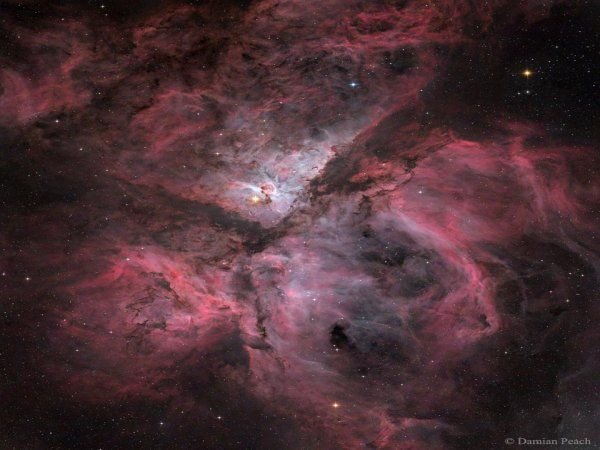
The Great Nebula in Carina
In one of the brightest parts of Milky Way lies a nebula where some of the oddest things occur. NGC 3372, known as the Great Nebula in Carina, is home to massive stars and changing nebulas. The Keyhole Nebula (NGC 3324), the bright structure just ...

Rainbow Airglow over the Azores
Why would the sky glow like a giant repeating rainbow? Airglow. Now air glows all of the time, but it is usually hard to see. A disturbance however -- like an approaching storm -- may cause noticeable rippling in the Earth's atmosphere. These ...

Alaskan Moondogs
What's happened to the sky? Moonlight illuminates a snowy scene in this night land and skyscape made on 2013 January from Lower Miller Creek, Alaska, USA. Overexposed near the mountainous western horizon is the first quarter Moon itself, ...

A Picturesque Equinox Sunset
What's that at the end of the road? The Sun. Many towns have roads that run east - west, and on two days each year, the Sun rises and sets right down the middle. Today is one of those days: an equinox. Not only is today a day of equal night ...
Internationale Raumstation
Kauf uns einen Kaffee!


