
ISS from Wallasey
After sunset on March 28, the International Space Station climbed above the western horizon, as seen from Wallasey, England at the mouth of the River Mersey. Still glinting in the sunlight some 400 kilometers above planet Earth, the fast moving ...

Pan-STARRS Across the Sky
This astronomical sky spanning view is a mosaic from the Pan-STARRS observatory. The images were recorded with its 1.8 meter telescope at the summit of Haleakala on planet Earth's island of Maui. In fact, Earth's north celestial pole is centered ...

Messier 2
After the Crab Nebula, M1, this giant star cluster is the second entry in 18th century astronomer Charles Messier's famous list of things with are not comets. M2 is one of the largest globular star clusters now known to roam the halo of our Milky ...

Wisps Surrounding the Horsehead Nebula
The famous Horsehead Nebula in Orion is not alone. A deep exposure shows that the dark familiar shaped indentation, visible just below center, is part of a vast complex of absorbing dust and glowing gas. To bring out details of the Horsehead's ...
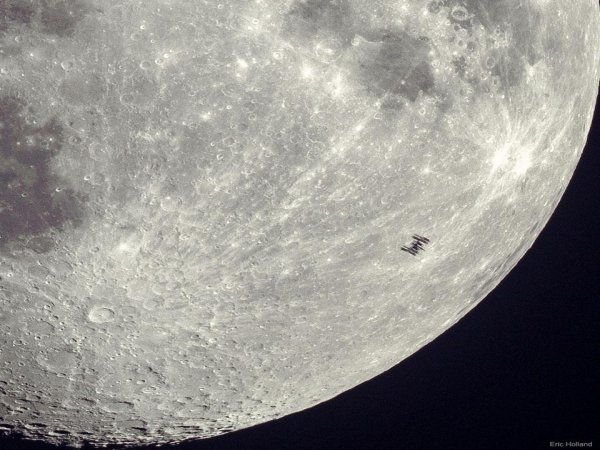
Space Station Silhouette on the Moon
What's that unusual spot on the Moon? It's the International Space Station. Using precise timing, the Earth-orbiting space platform was photographed in front of a partially lit gibbous Moon last month. The featured image was taken from Palo Alto, ...

Astronaut Kicks Lunar Field Goal
Score three points for NASA. With time running out late in Apollo 15's mission to the Moon in 1971, Astronaut David Scott prepared to split the uprights and bring about yet another dramatic end-of-the-mission victory for NASA. Scott used a ...

Markarian's Chain of Galaxies
Across the heart of the Virgo Cluster of Galaxies lies a striking string of galaxies known as Markarian's Chain. The chain, pictured here, is highlighted on the right with two large but featureless lenticular galaxies, M84 and M86. Prominent to ...

3D 67P
Put on your red/cyan glasses and float next to the jagged and double-lobed nucleus of Churyumov-Gerasimenko, also known as Comet 67P. The stereo anaglyph was created by combining two images from the Rosetta spacecraft's narrow angle OSIRIS camera ...
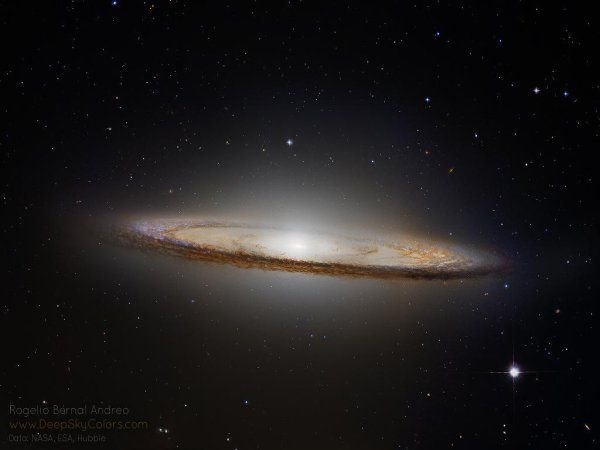
M104: The Sombrero Galaxy
The striking spiral galaxy M104 is famous for its nearly edge-on profile featuring a broad ring of obscuring dust lanes. Seen in silhouette against an extensive central bulge of stars, the swath of cosmic dust lends a broad brimmed hat-like ...

The Gaia Stars of M15
Messier 15 is a 13 billion year old relic of the early formative years of our galaxy, one of about 170 globular star clusters that still roam the halo of the Milky Way. About 200 light-years in diameter, it lies about 35,000 light years away ...
Internationale Raumstation
Kauf uns einen Kaffee!

