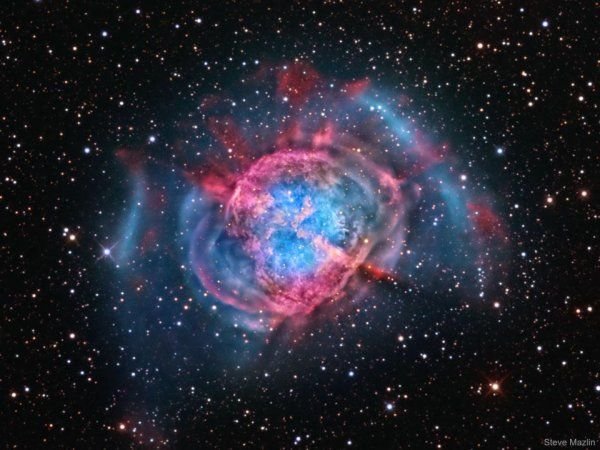
M27: The Dumbbell Nebula
Is this what will become of our Sun? Quite possibly. The first hint of our Sun's future was discovered inadvertently in 1764. At that time, Charles Messier was compiling a list of diffuse objects not to be confused with comets. The 27th object ...

Mercury Crosses a Quiet Sun
What's that black dot crossing the Sun? The planet Mercury. Mercury usually passes over or under the Sun, as seen from Earth, but last month the Solar System's innermost planet appeared to go just about straight across the middle. Although ...

Starburst Galaxy M94 from Hubble
Why does this galaxy have a ring of bright blue stars? Beautiful island universe Messier 94 lies a mere 15 million light-years distant in the northern constellation of the Hunting Dogs (Canes Venatici). A popular target for Earth-based ...

Star Trails for a Red Planet
Does Mars have a north star? In long exposures of Earth's night sky, star trails make concentric arcs around the north celestial pole, the direction of our fair planet's axis of rotation. Bright star Polaris is presently the Earth's North Star, ...

Galileo's Europa Remastered
Looping through the Jovian system in the late 1990s, the Galileo spacecraft recorded stunning views of Europa and uncovered evidence that the moon's icy surface likely hides a deep, global ocean. Galileo's Europa image data has been remastered ...

Moon and Planets at Twilight
This week's ongoing conjunction of Venus and Jupiter may have whetted your appetite for skygazing. Tonight is the main course though. On November 28, a young crescent Moon will join them posing next to the two bright planets above the western ...

Hoag's Object: A Nearly Perfect Ring...
Is this one galaxy or two? This question came to light in 1950 when astronomer Arthur Hoag chanced upon this unusual extragalactic object. On the outside is a ring dominated by bright blue stars, while near the center lies a ball of much redder ...

Venus and Jupiter on the Horizon
What are those two bright objects on the horizon? Venus and Jupiter. The two brightest planets in the night sky passed very close together -- angularly -- just two days ago. In real space, they were just about as far apart as usual, since ...

NGC 6995: The Bat Nebula
Do you see the bat? It haunts this cosmic close-up of the eastern Veil Nebula. The Veil Nebula itself is a large supernova remnant, the expanding debris cloud from the death explosion of a massive star. While the Veil is roughly circular in ...

Apollo 12: Self-Portrait
Is this image art? 50 years ago, Apollo 12 astronaut-photographer Charles "Pete" Conrad recorded this masterpiece while documenting colleague Alan Bean's lunar soil collection activities on Oceanus Procellarum. The featured image is dramatic ...
Internationale Raumstation
Kauf uns einen Kaffee!

