
From the Pleiades to the Eridanus Loop
If you stare at an interesting patch of sky long enough, will it look different? In the case of Pleiades and Hyades star clusters -- and surrounding regions -- the answer is: yes, pretty different. Long duration camera exposures reveal an ...

Comet ATLAS and the Mighty Galaxies
Comet ATLAS C/2019 Y4 was discovered by the NASA funded Asteroid Terrestrial-impact Last Alert System, the last comet discovery reported in 2019. Now growing brighter in northern night skies, the comet's pretty greenish coma is at the upper left ...

Morning, Planets, Moon and Montreal
Dawn's early light came to Montreal, northern planet Earth, on March 18, the day before the vernal equinox. At the end of that nearly equal night the Moon stands above a dense constellation of urban lights in this serene city and skyscape. Of ...
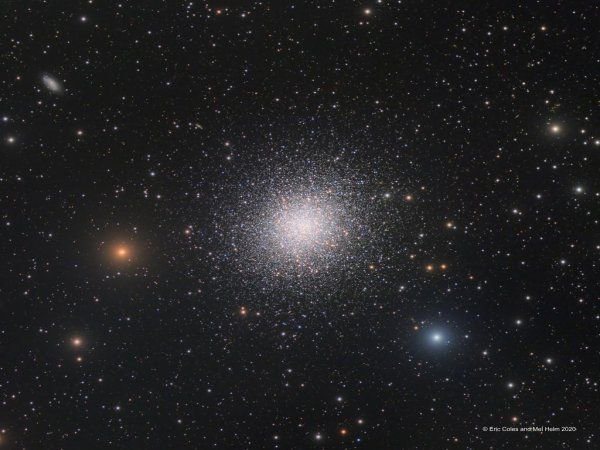
M13: The Great Globular Cluster in...
In 1716, English astronomer Edmond Halley noted, "This is but a little Patch, but it shews itself to the naked Eye, when the Sky is serene and the Moon absent." Of course, M13 is now less modestly recognized as the Great Globular Cluster in ...

Anticrepuscular Rays over Florida
What's happening behind those clouds? Although the scene may appear somehow supernatural, nothing more unusual is occurring than a Sun setting on the other side of the sky. Pictured here are anticrepuscular rays. To understand them, start by ...

M77: Spiral Galaxy with an Active Center
What's happening in the center of nearby spiral galaxy M77? The face-on galaxy lies a mere 47 million light-years away toward the constellation of the Sea Monster (Cetus). At that estimated distance, this gorgeous island universe is about 100 ...

A Moon Dressed Like Saturn
Why does Saturn appear so big? It doesn't -- what is pictured are foreground clouds on Earth crossing in front of the Moon. The Moon shows a slight crescent phase with most of its surface visible by reflected Earthlight known as ashen glow. The ...

The Snows of Churyumov-Gerasimenko
You couldn't really be caught in this blizzard while standing by a cliff on Churyumov-Gerasimenko. Orbiting the comet -- frequently abbreviated as 67P or CG -- in June of 2016, the Rosetta spacecraft's narrow angle camera did record streaks of ...

Moonrise and Mountain Shadow
What phase of the Moon is 3.14 radians from the Sun? The Full Moon, of course. Even though the Moon might look full for several days, the Moon is truly at its full phase when it is 3.14 radians (aka 180 degrees) from the Sun in ecliptic ...

Starry Night by Jean-Francois Millet
A dramatic nocturnal landscape from around 1850, this oil painting is the work of French artist Jean-Francois Millet. In the dark and atmospheric night sky are shooting stars, known too as meteors, above a landscape showing a path through the ...
Internationale Raumstation
Kauf uns einen Kaffee!

