
M2-9: Wings of a Butterfly Nebula
Are stars better appreciated for their art after they die? Actually, stars usually create their most artistic displays as they die. In the case of low-mass stars like our Sun and M2-9 pictured here, the stars transform themselves from normal ...

A Thousand Meteors
Over a thousand meteors flash through the night in this intriguing timelapse video. Starting in April 2019 the individual video frames were selected from 372 relatively clear nights of imaging from an automated wide-field observatory in rural New ...

The Reappearance of Mars
Mars reappears just beyond the Moon's dark limb in this stack of sharp video frames captured on September 6. Of course to reappear it had to disappear in the first place. It did that over an hour earlier when the sunlit southern edge of the ...

Jupiter's Swmimming Storm
A bright storm head with a long turbulent wake swims across Jupiter in these sharp telescopic images of the Solar System's ruling gas giant. Captured on August 26, 28, and September 1 (left to right) the storm approximately doubles in length ...
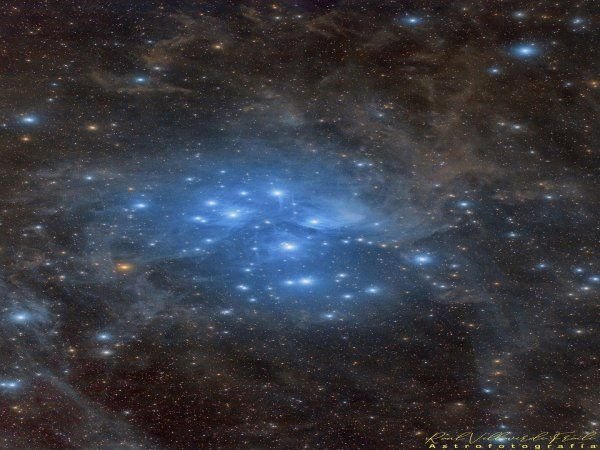
Pleiades: The Seven Sisters Star Cluster
Have you ever seen the Pleiades star cluster? Even if you have, you probably have never seen it as large and clear as this. Perhaps the most famous star cluster on the sky, the bright stars of the Pleiades can be seen without binoculars from even ...

GW190521: Unexpected Black Holes Collide
How do black holes like this form? The two black holes that spiraled together to produce the gravitational wave event GW190521 were not only the most massive black holes ever seen by LIGO and VIRGO so far, their masses -- 66 and 85 solar masses ...

The Milky Way over St Michael's Mount
Where do land and sky converge? On every horizon -- but in this case the path on the ground leads to St Michael's Mount (Cornish: Karrek Loos yn Koos), a small historic island in Cornwall, England. The Mount is usually surrounded by shallow ...
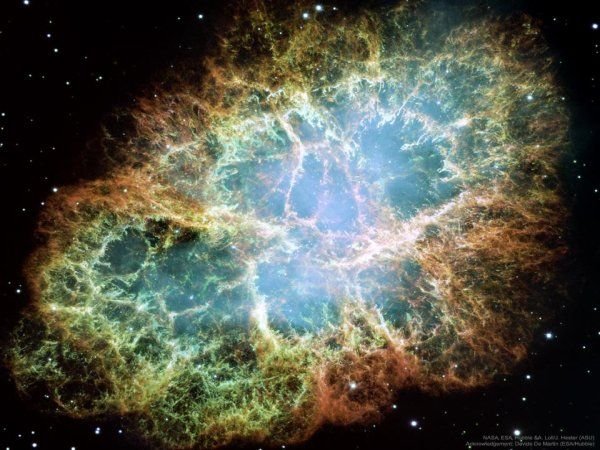
M1: The Crab Nebula from Hubble
This is the mess that is left when a star explodes. The Crab Nebula, the result of a supernova seen in 1054 AD, is filled with mysterious filaments. The filaments are not only tremendously complex, but appear to have less mass than expelled in ...

A Falcon 9 Moon
Illuminating planet Earth's night, full moons can have many names. This year the last full moon of northern hemisphere summer was on September 2, known to some as the Full Corn Moon. A few days earlier on August 30 this almost full moon rose just ...

The Wizard Nebula
Open star cluster NGC 7380 is still embedded in its natal cloud of interstellar gas and dust popularly known as the Wizard Nebula. Seen on the left, with foreground and background stars along the plane of our Milky Way galaxy it lies some 8,000 ...
Internationale Raumstation
Kauf uns einen Kaffee!

