
AR2835: Islands in the Photosphere
Awash in a sea of incandescent plasma and anchored in strong magnetic fields, sunspots are planet-sized dark islands in the solar photosphere, the bright surface of the Sun. Found in solar active regions, sunspots look dark only because they are ...

Perseverance Selfie with Ingenuity
On sol 46 (April 6, 2021) the Perseverance rover held out a robotic arm to take its first selfie on Mars. The WATSON camera at the end of the arm was designed to take close-ups of martian rocks and surface details though, and not a quick snap ...

Simulation: Formation of the First Stars
How did the first stars form? To help find out, the SPHINX computer simulation of star formation in the very early universe was created, some results of which are shown in the featured video. Time since the Big Bang is shown in millions of years ...
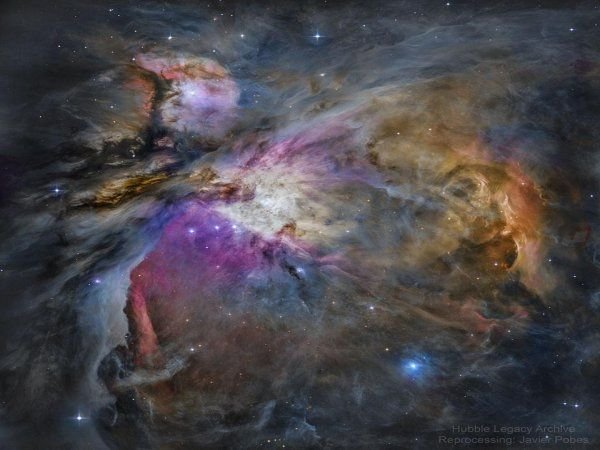
Orion Nebula: The Hubble View
Few cosmic vistas excite the imagination like the Orion Nebula. Also known as M42, the nebula's glowing gas surrounds hot young stars at the edge of an immense interstellar molecular cloud only 1,500 light-years away. The Orion Nebula offers one ...

A Paper Moon Solar Eclipse
It may look like a paper Moon. Sailing past a canvas Sun. But those are not cardboard clouds. And it's not make believe. The featured picture of an orange colored sky is real -- a digital composite of two exposures of the solar eclipse that ...

The Dancing Auroras of Saturn
What drives auroras on Saturn? To help find out, scientists have sorted through hundreds of infrared images of Saturn taken by the Cassini spacecraft for other purposes, trying to find enough aurora images to correlate changes and make movies. ...

Pixels in the Sun
These two panels, composed of video frames made with a safe solar telescope and hydrogen alpha filter, show remarkably sharp details on the solar disk and giant prominences along the Sun's edge on June 6 (top) and June 18. Taken from Beijing, ...

Andromeda in a Single Shot
How far can you see? The Andromeda Galaxy, 2.5 million light years away, is the most distant object easily seen by the unaided eye. Other denizens of the night sky, like stars, clusters, and nebulae, are typically hundreds to thousands of ...

Messier 99
Grand design spiral galaxy Messier 99 looks majestic on a truly cosmic scale. This recently processed full galaxy portrait stretches over 70,000 light-years across M99. The sharp view is a combination of ultraviolet, visible, and infrared image ...

STARFORGE: A Star Formation Simulation
How do stars form? Most form in giant molecular clouds located in the central disk of a galaxy. The process is started, influenced, and limited by the stellar winds, jets, high energy starlight, and supernova explosions of previously existing ...
Internationale Raumstation
Kauf uns einen Kaffee!

