
Apollo 11: Onto a New World
A human first set foot on another world on July 20, 1969. This world was Earth's own Moon. Pictured above is Neil Armstrong preparing to take the historic first step. On the way down the Lunar Module ladder, Armstrong released equipment which ...
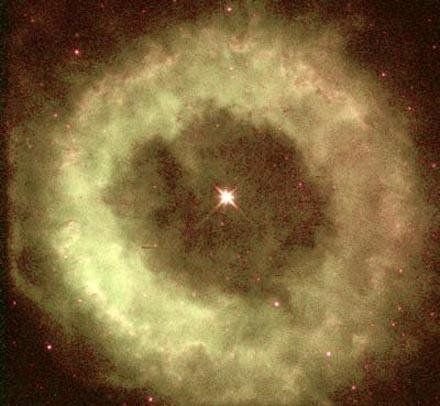
NGC 6369: A Donut Shaped Nebula
Why isn't the star in the center of the nebula? NGC 6369 appears to be a fairly ordinary planetary nebula. It can be seen with a good telescope in the constellation of Ophiuchus. The gas expelled by the central star is bunched in the shape of a ...

Our Solar System from Voyager
After taking spectacular pictures of our Solar System's outer planets, Voyager 1 looked back at six planets to take our Solar System's first family portrait. Here Venus, Earth, Jupiter, Saturn, Uranus, and Neptune, were all visible across the ...

Helios Helium
This image of the relatively quiet Sun was made using ultraviolet light emitted by ionized Helium atoms in the Solar chromosphere. Helium was first discovered in the Sun in 1868, its name fittingly derived from from the Greek word Helios, meaning ...

TRACE and the Active Sun
This dramatic high resolution picture looking across the edge of the Sun was taken April 24th by a telescope on board the newly launched Transition Region and Coronal Explorer (TRACE) satellite. It shows graceful arcs of intensely hot gas ...

Comet Stonehouse
Comets move against a field of background stars. Their apparent motion is slow but carefull tracking reveals their orbits, allowing these visitors to the inner solar system to be identified as old or new acquaintances. Recently a new comet, ...

Occultations and Rising Moons
On April 23, the rising crescent Moon occulted (passed in front of) Venus and Jupiter. The double occultation was a rare event and only visible from certain locations tracing a path across Earth's surface. This dramatic telephoto picture was ...

Callisto Enhanced
Callisto is half rock and half ice. This moon of Jupiter is approximately the size of the planet Mercury, making it the third largest moon in the Solar System, after Ganymede and Titan. Callisto's icy surface is billions of years old, lacks any ...

Callisto in True Color
Callisto's surface has many stories to tell. The most distant of Jupiter's Galilean Moons, Callisto shows the highest density of impact craters in the Solar System, but harbors no volcanoes or even any large mountains. Callisto's surface is ...

Skylab Over Earth
Skylab was an orbiting laboratory launched by a Saturn V rocket in May 1973. Skylab was visited three times by NASA astronauts who sometimes stayed as long as two and a half months. Many scientific tests were performed on Skylab, including ...
Internationale Raumstation
Kauf uns einen Kaffee!

